I am an English teacher, mother, and wife, but I love to write. I feel that I am blessed to be able to use my talent to write about my children's books, poems, short fiction, and parenting. Please feel free to contact me with any questions you may have about my experiences with beginning a writing career while focusing on my children and my job. I look forward to comments and to hear from my readers!
This weekend our broody surrogate hen hatched seven chicks from her
clutch of eleven. To ensure the safety of the mother hen and chicks,
we moved them to the back of our largest coop. The nesting boxes where
the chicks were hatched has a separate room with a door. Closing the door
to the nesting boxes allows the hen and her chicks safety from Jake,
our Tom turkey, and Greg, our large rooster.
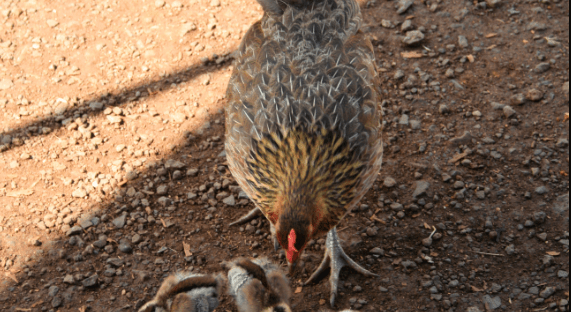
Buff and Surrogate Chicks
Mother hens are seriously protective of their young. They are quite capable
of protecting the chicks by themselves, but adult diseases inside our main
coop could kill the biddies. The Mother hen will remain with the chicks for
six to eight weeks before she will want to rejoin the flock and begin
laying eggs again. When the chicks are 18 weeks, they can be introduced
to the flock or be moved to a separate coop. As they grow, it will be
important to determine how many roosters are mixed into the group. They
will need to be transferred to new homes and not introduced to the flock.
We are not sure what we will do with any roosters that are growing at this
time. I will update you on the two sets of biddies soon.
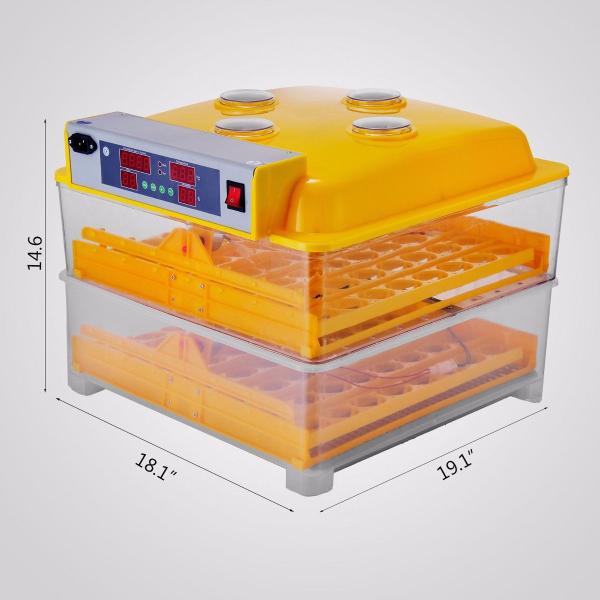
My husband is always eager to go to the SALE; most of the time, he doesn’t even let me know what he’s planning on purchasing. The first time I went with him to the SALE in Gray, Georgia, his first purchase was an incubator that turns 96 eggs at a time. I assumed that was an ever so slight hint that I was free to learn about incubating my eggs.
So, I began researching some topics like: how do I use our incubator? how do I prepare the eggs for incubation? how do I ensure eggs are developing? First, I learned that our incubator automatically turns the eggs every 60 minutes.
Best Choice Products 96 Digital Clear Egg Incubator Hatcher Automatic Egg Turning Temperature Control
The turning ensures that the chicks adequately develops and do not adhere to the sides of the egg membranes. The incubator keeps the eggs at a constant temperature of 100 degrees Fahrenheit as well as constant humidity levels needed to promote proper development for the twenty one day incubation period. Our incubator that is pictured above will alarm if the humidity drops below 41 percent or the temperature drops below 37.8 degrees Celsius.
When I hear the alarm, I can add water or change the setting for the temperature so that the eggs have proper incubation conditions. A chicken egg takes 21 days to hatch. A turkey egg takes 28 days to hatch whereas a duck egg takes 35 days. I only had to add water one time during the 21 day period, and it’s important that the last three days has a humidity percentage of 50 or higher.
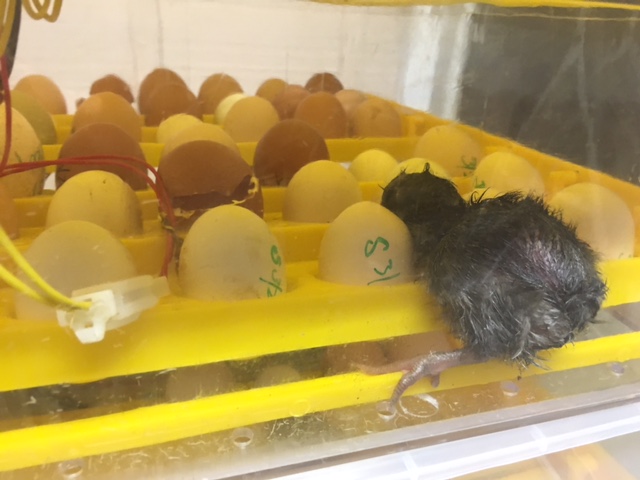
This Saturday was HATCH DAY!! Inside our incubator, I placed barnyard mixed chicken eggs inside the top tray on 3.24 and 3.25. On the bottom tray, I placed turkey eggs and silver sebright eggs that were dated 3.30.18. I had one Mille Fleur with the most handsome feathered feet, several Marans and Buffs. The last two eggs to hatch were my Americaunas.
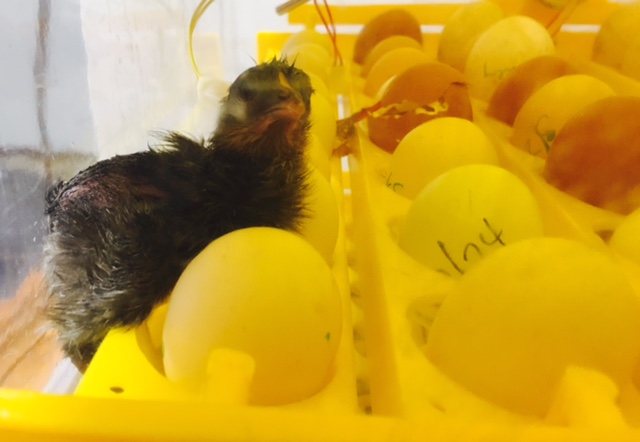
March 24, 2018 Hatchling
The children, Chris, and I awoke Saturday morning to the chirping and peeping of freshly hatched chicks. These chicks were then placed in our brooder with Ernest the turkey and the two Maran chicks that the FFA students hatched last week. As Saturday and Sunday progressed, we had twenty biddies. They were placed inside our brooder. The brooder is a cow trough with a heat lamp, pine shavings, water, and chick starter feed. The brooder is inside our shed that eliminates the possibility for drafts or predators. This post will be followed by how to properly brood chicks by weekly milestones.
Notice the labels I wrote on the eggs helped me keep track of hatch day.
When we began this fowl journey, my husband bought a mated pair of Merriam turkeys. I was instantly intrigued with the turkeys; we had chickens when I was a little girl. However, we never had turkeys. I named the pair: Jenny and Jake. The couple live in our largest coop with twenty-two hens and one rooster.
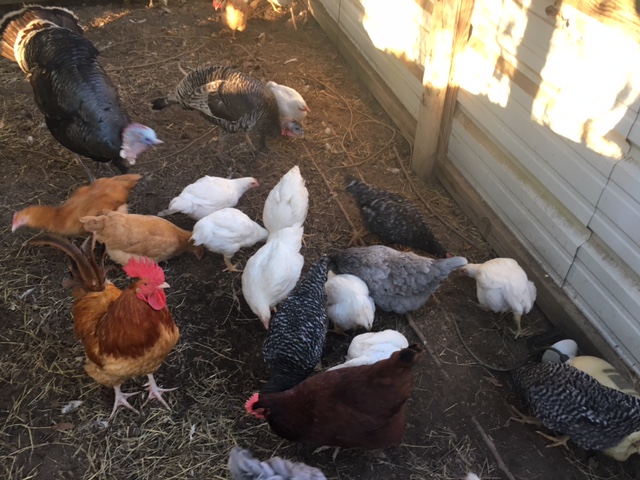
Jenny and Jake enjoy scratching.
There hasn’t been many problems with the birds except that Jake often bullies everyone but Jenny when I distribute the scratch feed. With an ego like his, he is determined to eat first. He spent the majority of January and February drumming and courting Jenny who often appeared to not respond to him, but obviously, by March she was receptive to his advances. I needed to learn more of the mating rituals of wild turkeys .
A Love Game
In the wild, Jake and Jenny would have had a home range, and inside this home range, males would have their heircharies with female heirches existing as well. Both sexes would feel more inclined to find a mate during longer daylight hours, which triggers a hormonal response. The hormonal changes inside each animal would lead to courtship rituals, and it seems that my mated pair of turkeys arrived at our farm just in time to court (https://www.nwtf.org/hunt/wild-turkey-basics/lifestyle-breeding).
Rituals include elaborate strutting and gobbling in the male turkeys. Even in January, Jake was drumming and prostrating his rituals around Jenny for hours everyday.
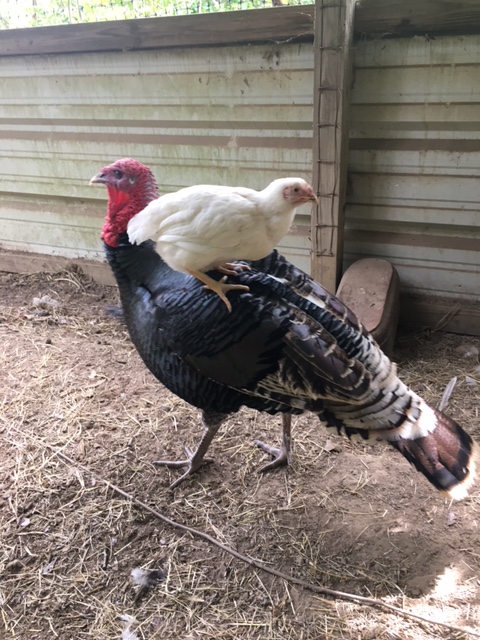
Letting Boo ride on his back is not one of Jake’s mating rituals.
She often moved far away from him in those colder months without much response, but by March, I could see her response to her mate changed. Since there are no other males to select in our coop, Jenny showed her affection to Jake by bowing or crouching in front of him many times during the day, starting in March. I often mentioned her change of behavior to Chris, but I never got to see them mate, so I just assumed it never happened!! NOT!!
Suddenly in the middle of March, Jenny made a nest on the ground out of dirt by the nesting boxes. Based on my research, if Jenny were in the wild, she would make a similar nest under dense brush so that she would be camouflaged. Jenny began laying four eggs a day around the Ides of March. Female hens will lay a clutch of ten to fourteen eggs and begin to sit on the nest when the clutch is finished. Then, a wild or domesticated hen will sit upon the nest, leave only to eat, and turn the eggs each hour to ensure proper flow of oxygen, to keep the embryo from adhering to the membranes, to regulate temperature, to stimulate vessel growth, and to move the chick into hatching position. In addition to laying and turning, turkey hens must wait 26 to 28 days for the hatching of a poult.
A New Life
Unfortunately, when Jenny had laid the fifth egg, I found that my chicken hens began to peck the eggs in the nest and break some. I decided to incubate the eggs as she laid them. The first two eggs I found went to Wilcox High with me on March 15, 2018, so that my students could incubate those eggs in Ag Science. Our lovely and talented Mrs. Addie Tucker, FFA leader and Agriculture teacher, helped with them each day and allowed them to brood after hatching.
April 11, 2018 during first block class, we saw that one of the poults had begun to peck his way out of his shell. If this poult were in our coop or in the wild, at this stage the mother would imprint on the chick by making random clucks to stimulate future learning and socialization. However, in our incubated situation, the pout was cheered on by excited high school students. By 3:30 pm that afternoon, a new life could be found resting in the homemade brooder.
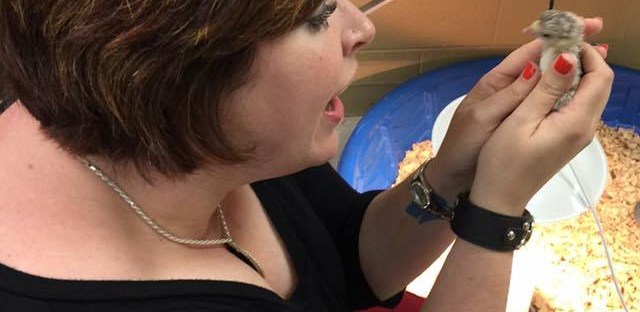
Baby talk helps 🙂
Poult One
Today, I will take them home to our brooder which contains our two previous hatched chicks. Saturday, I will have more chickens to add to the brooder with five more turkey eggs to hatch the following Saturday. Now, I get to love and care for these little miracles, and I will research the development of the poults.
The Development Process
If Jenny were raising the poults in the wild, at two days old the chicks would be grooming, watering, and feeding. By the end of the first week, they would be able to dust themselves beside their mother. By the end of the second week, the poults would fly short distances, followed by roosting in trees with the hen due to a change in diet from insects to plants.
At 14 weeks, our poults will have distinguishing features of a male turkey or female turkey. Poults at this age can survive more easily in the wild, and by fall, the siblings will have a pecking order and be well socialized to fit into other flocks. My students, my children, and myself are so excited to document the poults journey to adulthood. I eagerly await their development milestones, and I can’t wait to document Jenny as she meets her babies for the first time.
This week I’ve had my first experience with a moody, broody hen. I must admit that I am very proud of her because she has taken it upon herself to sit on a nesting box that holds a hodgepodge of other hen’s eggs.
Last week, I began to notice that most of our laying hens were choosing one of the lowest, middle nesting boxes to lay their eggs. Each day, there would be two or three mixed colored eggs until that particular box contained ten eggs. Next, those laying hens took the adjoining box and laid each day.
Finally, these egg layers had two adjacent nesting boxes filled with ten eggs of varying origins. However, I noticed that only the original box had warm eggs. Which one of my beautiful future mothers was sitting upon these eggs? For four days, I fed the chickens without seeing the broody hen, but on the fifth day, I found her. She was one of the Rhode Island Red hens with the black tipped tail. Our little Dollie is a very moody, broody girl.
I decided to leave the eggs with her inside the original nesting box, but take eggs inside the adjacent box because none of the other hens were broody. It was important to let Dollie finish out her three week quest to become a surrogate because a moody, broody hen without chicks can injure herself. Broody hens that never receive chicks will refuse to leave the nest and begin to refuse to eat or drink. Some chicken experts will purchase or incubate chicks to allow a broody hen to raise them so that her mood will break, and she will no longer have the drive to sit.
I am very excited to see how Dollie’s broody mood ends; I hope it ends in ten healthy chicks. They would be our first chicks incubated and brooded naturally without our intervention. So again, I ask: why is a broody hen so moody? Because she is FRITO-LAY
While doing research about caring for my sick birds, the best advice I found was: isolate a sick bird from the flock. I wanted someplace I could keep the sick bird or birds and have quick, easy access to them. While at the sale, Chris purchased a large bird cage.
Chicken Hospital
I keep the cage on the back porch so that I can check on the birds several times a day, feed and water them by hand, administer medication as needed.
Also, I assess symptoms and determine what illness my pets have. Three weeks ago, I noticed my Mille Fleur hens were acting sickly. I recognized that neither one of the hens were laying eggs anymore. However, I had added three bantam hens to the coop, so I dismissed this symptom as “STRESS.” On day two without eggs,
I noticed that one of the hens had swollen eyes and was struggling to breathe. She was quarantined right away. The chicken hospital had its first patient. I felt anxious about caring for her because Chris had foolishly spent seventy dollars on her and her roster at the sale. Because of her beauty, I vowed to keep her alive. I contacted a local vet for advice, and she agreed that her sinuses were filled with mucus that was causing swelling of her eyes and hardening of mucus inside her nostrils.
Treating the Ill Chickens
Chris and Bailey made a trip to Tractor Supply and purchased the antibiotic, Tylan. Tylan is a broad spectrum antibiotic that can be given by mouth. I chose this type because I was feeding the hen by hand because she refused to eat.
I also fed her pedialyte for infants with a dropper. For the first two days, I gave her pedialyte three times a day, and during the third feeding, I would add the Tylan to the dropper. The amount of Tylan given to Honey, the Mille Fleur, was based on her weight.
Mille Fleur Hens and Rooster
Before putting her on the roost, I also put warm compresses on her eyes and cleared her nostrils. By the end of the week, Honey looked so much better and began eating and drinking on her own. Unfortunately, her rooster, Mr. Big, showed similar symptoms on day five of her hospital stay. In a previous blog, I mentioned that chicken illness are highly contagious, which includes sinus and respiratory infections.
Learning from my Experiences
Upon seeing similar symptoms, Mr. Big was isolated from the other hens inside his coop and placed into the hospital with Honey. At the time of Mr. Big’s hospital stay, he was still eating and drinking on his own (I believe that I am getting better with noticing symptoms of sickness). So, I treated him with Tylan by placing it inside his water each day; so far, he and Honey continue to improve daily. Chris and I have decided to purchase a separate coop for the Mille Fleurs, and before we find a few more hens to cohabit with the pair, we will keep new hens together in quarantine so that new chickens do not expose our flock to new illnesses.
Although I am better at animal husbandry than I was at the beginning of our family project, I still occasionally find a dead hen or rooster that never displayed symptoms of sickness. Most of the time, chickens display symptoms after their little bodies are very weak.
BB Red Bantam Rooster
Yesterday, Chris found our BB Red rooster dead in our largest coop. He was one of our older bantams, but he had showed no weakness prior to his passing. I am still learning to care for my flock, and I hope I get better at recognizing illness and treating sick chickens before it’s too late. We will miss you, B.B.
Post Script—
My childhood best friend, Bubba Hendrix passed away April 4, 2018. I will miss you dearly. I love you, my friend.
Last week, my daughter found our Sultan hen dead inside our smallest coop. She had been our favorite and the gentlest chicken. We had showered Sookie with love since bringing her home, and I must admit that it was tough to prepare to bury her with my husband and kids.
Sookie–my little Sultan
A mourning period has no place in chicken rearing because I need to find out what made her sick and protect my flock from further disease. Since her death, I have researched many illnesses that chickens are prone to suffer from, and I realize that I need to better recognize a sick bird. Some signs and symptoms of sickness in chickens are:
Comb Issues
A chicken’s comb can reveal so much about its health. If your chicken’s comb is pale, limp, warm, or has sores, there are health concerns to examine. First, a chicken could have an enlarged comb that is very warm. These traits can mean a fever due to an infection or virus. On the other hand, combs that are limp or pale could signal sickness as well.
Respiratory Problems
Chickens with breathing difficulties exhibit symptoms of a viral or bacterial infection. How would I recognize these problems? Signs and symptoms of respiratory illnesses are: sneezing, sniffling, running nose, and watering eyes. Unfortunately, respiratory illnesses are CONTAGIOUS.
Feather Concerns
When beloved birds lose feathers outside of molting, those birds could be ill. Broody hens will pluck their breast feathers, and chickens who are bullying other members of the flock can pluck out targeted chicken’s feathers. However, parasites cause the infected chicken’s feathers to fall out. It is possible that chickens can suffer from lice or red mites.
Dropping Changes
A sick chicken will also exhibit changes in its excrement. Diarrhea is NEVER normal in your flock. Diarrhea has many causes; such as: drinking too much water, suffering from worms, or exhibiting symptoms of intestinal disease.
Appetite Decreases
Sick chickens will have a decrease in appetite. Any animal who will not eat is a SICK animal.
Laying Halts
A hen may stop laying for several reasons. One issue could be that an egg is stuck in the vent. A trapped egg will cause death to the hen. In addition to a trapped egg, a hen will stop laying due to environmental changes like temperature extremes and lack of food or water. On the other hand, diseases will also cause a hen to stop laying eggs. Keep a close eye on egg production when trying to monitor sickness in your flock.
Wing Worries
Sometimes sick birds will have droopy wings along with signs of tremors or strange neck and head movements. Watch your flock for these symptoms. All aforementioned symptoms can warn of serious illness. My upcoming blog post will discuss how to treat symptoms and care of ill birds.
January 10, 2016, Chris and I went on our first date, which lead to a long term relationship, a June wedding, and our baby boy. The hardest part of blending our homes was bonding with each other’s children. Chris made it look so easy! My girls quickly bonded with him, and they loved him almost immediately. On the other hand, Chris’ daughter seemed reluctant to get to know me. I can only imagine how hard it was on her, his only child, to have four new people move into her childhood home. She also had to share her daddy with us; I can only imagine how her nine-year-old thoughts and emotions raced with confusion. How would she accept a larger, blended family? How would she maintain a strong relationship with her daddy with a new step family and a new brother?
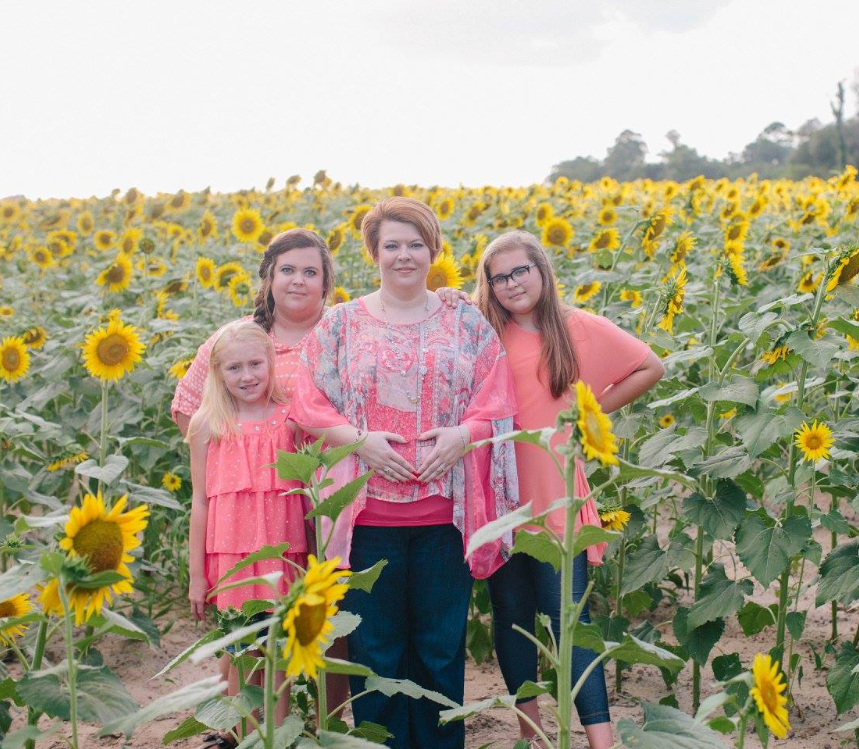
The Girls and I
I’ve ruminated over Bailey’s struggle for two years now. I often wondered how I could help her transition. I needed her to feel safe, loved, and appreciated. How could I help? My husband tends to be intrinsically and emotionally motivated to do good deeds for other people; I often observe him helping others even when I do not agree with his decisions to do “the right thing.” I have learned many lessons from him in the last two and a half years about unconditional love and support of others. I analyze his behavior
Bailey and Our Smallest Hens
and motives quite often in my mind, wondering if I too could make the right decision when faced with an ungrateful, undeserving person in need. My contemplation leads me to only one conclusion about his decision to bring home our chickens: to strengthen our family’s bond. I was unable to predict that the daily caring of our hens, roosters, and turkeys would lead to Bailey and me growing closer as step-daughter and step-mother.
My grandmother often told me that the Lord works in mysterious ways, but who knew that He could work through a bunch of yard birds. Each day we feed, water, and commune with our fouls. Bailey meticulously takes up eggs each afternoon for incubation, and together we turn and clean them. This weekend, I will put this week’s egg in our incubator for our first round of hatchlings.
When Bailey spends the weekend with her mom, I know her mom will hear all about her chickens and our daily musings about them. She often brings family members to our house to see our coops, and she always asks me to take her out there. I love Bailey. I love my chickens, and maybe one day, we can ALL love each other.















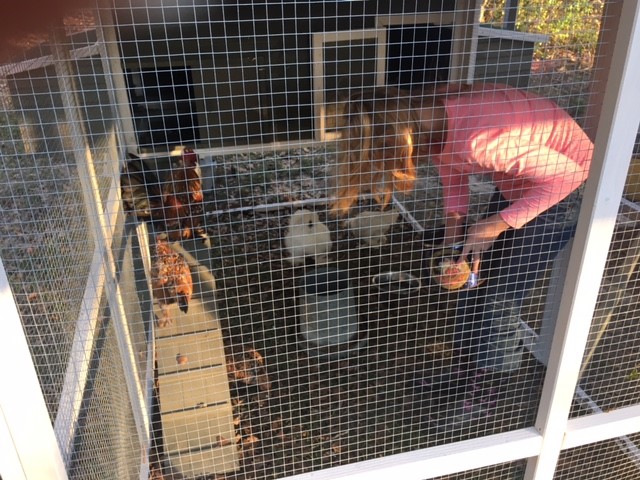
 Curvaceous Chick's Coop