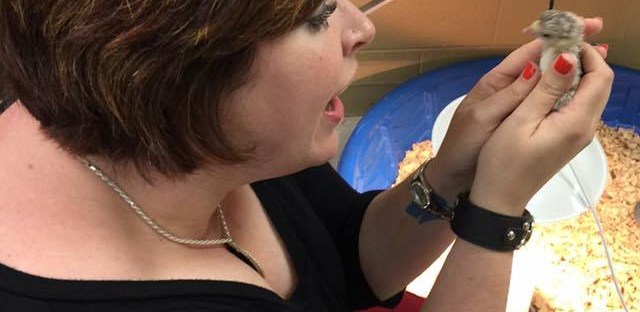
The Love Birds
When we began this fowl journey, my husband bought a mated pair of Merriam turkeys. I was instantly intrigued with the turkeys; we had chickens when I was a little girl. However, we never had turkeys. I named the pair: Jenny and Jake. The couple live in our largest coop with twenty-two hens and one rooster.

There hasn’t been many problems with the birds except that Jake often bullies everyone but Jenny when I distribute the scratch feed. With an ego like his, he is determined to eat first. He spent the majority of January and February drumming and courting Jenny who often appeared to not respond to him, but obviously, by March she was receptive to his advances. I needed to learn more of the mating rituals of wild turkeys .
A Love Game
In the wild, Jake and Jenny would have had a home range, and inside this home range, males would have their heircharies with female heirches existing as well. Both sexes would feel more inclined to find a mate during longer daylight hours, which triggers a hormonal response. The hormonal changes inside each animal would lead to courtship rituals, and it seems that my mated pair of turkeys arrived at our farm just in time to court (https://www.nwtf.org/hunt/wild-turkey-basics/lifestyle-breeding).
Rituals include elaborate strutting and gobbling in the male turkeys. Even in January, Jake was drumming and prostrating his rituals around Jenny for hours everyday.
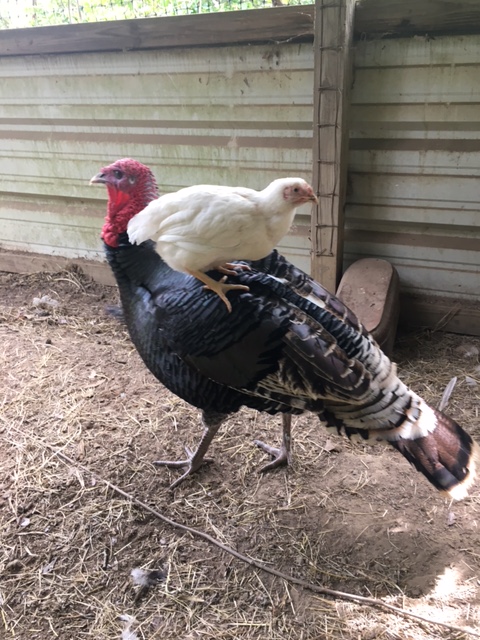
She often moved far away from him in those colder months without much response, but by March, I could see her response to her mate changed. Since there are no other males to select in our coop, Jenny showed her affection to Jake by bowing or crouching in front of him many times during the day, starting in March. I often mentioned her change of behavior to Chris, but I never got to see them mate, so I just assumed it never happened!! NOT!!
Suddenly in the middle of March, Jenny made a nest on the ground out of dirt by the nesting boxes. Based on my research, if Jenny were in the wild, she would make a similar nest under dense brush so that she would be camouflaged. Jenny began laying four eggs a day around the Ides of March. Female hens will lay a clutch of ten to fourteen eggs and begin to sit on the nest when the clutch is finished. Then, a wild or domesticated hen will sit upon the nest, leave only to eat, and turn the eggs each hour to ensure proper flow of oxygen, to keep the embryo from adhering to the membranes, to regulate temperature, to stimulate vessel growth, and to move the chick into hatching position. In addition to laying and turning, turkey hens must wait 26 to 28 days for the hatching of a poult.
A New Life
Unfortunately, when Jenny had laid the fifth egg, I found that my chicken hens began to peck the eggs in the nest and break some. I decided to incubate the eggs as she laid them. The first two eggs I found went to Wilcox High with me on March 15, 2018, so that my students could incubate those eggs in Ag Science. Our lovely and talented Mrs. Addie Tucker, FFA leader and Agriculture teacher, helped with them each day and allowed them to brood after hatching.
April 11, 2018 during first block class, we saw that one of the poults had begun to peck his way out of his shell. If this poult were in our coop or in the wild, at this stage the mother would imprint on the chick by making random clucks to stimulate future learning and socialization. However, in our incubated situation, the pout was cheered on by excited high school students. By 3:30 pm that afternoon, a new life could be found resting in the homemade brooder.


Today, I will take them home to our brooder which contains our two previous hatched chicks. Saturday, I will have more chickens to add to the brooder with five more turkey eggs to hatch the following Saturday. Now, I get to love and care for these little miracles, and I will research the development of the poults.
The Development Process
If Jenny were raising the poults in the wild, at two days old the chicks would be grooming, watering, and feeding. By the end of the first week, they would be able to dust themselves beside their mother. By the end of the second week, the poults would fly short distances, followed by roosting in trees with the hen due to a change in diet from insects to plants.
At 14 weeks, our poults will have distinguishing features of a male turkey or female turkey. Poults at this age can survive more easily in the wild, and by fall, the siblings will have a pecking order and be well socialized to fit into other flocks. My students, my children, and myself are so excited to document the poults journey to adulthood. I eagerly await their development milestones, and I can’t wait to document Jenny as she meets her babies for the first time.
#turkeylove #matedpairofturkeys #myfirstpoult #wildturkeys

 Curvaceous Chick's Coop
It’s so cool that you have your own coop!
LikeLike